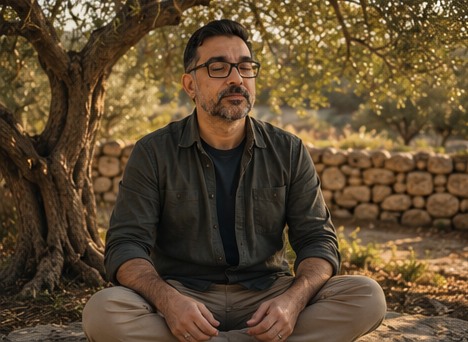
Mindfulness for ADHD
Learning to be present, one breath at a time.
I resisted mindfulness for years.
Like many people with ADHD, the idea of sitting still, focusing on my breathing and watching my thoughts sounded painfully boring. I couldn't understand why anyone would willingly spend twenty minutes doing… apparently nothing.
I was wrong.
Not because mindfulness suddenly became easy, but because I finally understood what it was really teaching me.
Mindfulness isn't about becoming a different person.
It's about learning to relate differently to the person you already are.

My Journey
I didn't discover mindfulness through a book or a course.
I discovered it because someone suggested I listen to Jon Kabat-Zinn.
At first I followed his guided practices almost reluctantly. I didn't expect anything to happen. I certainly didn't imagine it would become part of my daily life.
But something slowly changed.
Not overnight.
Not after a week.
Not even after a month.
The changes were so subtle that I almost missed them.
I became a little less reactive.
A little more patient.
A little more aware of what was happening inside me before I automatically responded.
Three years later, mindfulness has become one of the quiet constants in my life.
Not because I always enjoy practising it.
But because I value what it has gradually given me.

Support changes what is possible.
If I'm honest, I probably wouldn't still be practising mindfulness today without my wife, Sara.
Like many people with ADHD, as soon as something becomes repetitive or the results aren't immediately obvious, I'm tempted to abandon it. Mindfulness was no different. There were days when it felt boring, pointless or simply too much effort.
Sara quietly became my reminder.
Almost every day she would ask, "Have you practised mindfulness today?" Sometimes she'd simply say, "Let's do it together."
There was never any pressure or judgement.
Just a gentle invitation.
Looking back, I realise that mindfulness didn't become part of my life because I suddenly developed extraordinary discipline. It became part of my life because someone who loved me understood what I was trying to build, even when I couldn't always see it myself.
That experience reinforced something I now believe very strongly.
Our support systems matter.
Change rarely happens in isolation.
Sometimes another person simply walks beside us until the path becomes our own.
What Mindfulness Is (and Isn't)
Mindfulness is probably one of the most misunderstood practices in modern psychology.
It isn't emptying your mind.
It isn't forcing yourself to relax.
It isn't "thinking positively."
It isn't a religion.
Although mindfulness has its historical roots in Buddhist contemplative traditions, programmes such as Mindfulness-Based Stress Reduction (MBSR) and Mindfulness-Based Cognitive Therapy (MBCT) are taught as evidence-informed psychological approaches.
The goal isn't to stop having thoughts.
The goal is to notice them.
To become aware of your experience without immediately judging it or reacting to it.
Why It Can Help ADHD
One of the greatest challenges many people with ADHD experience isn't a lack of attention.
It's regulating attention.
Our minds move quickly.
Thoughts arrive before we're ready.
Emotions can become overwhelming.
We often react before we've had the opportunity to notice what's happening.
Mindfulness gently trains a different skill.
Not perfect attention.
Aware attention.
Each time the mind wanders and we notice it, we practise returning.
Again.
And again.
That returning is the practice.
Not staying perfectly focused.
The Neuroscience
Research over the past two decades suggests that regular mindfulness practice may strengthen the brain networks involved in attention regulation, emotional awareness and self-regulation.
For adults with ADHD, researchers such as Dr Lydia Zylowska have shown that mindfulness can become another valuable tool—not because it removes ADHD, but because it changes our relationship with distraction, impulsivity and emotional overwhelm.
Mindfulness doesn't cure ADHD.
Neither does coaching.
But together they can help us understand ourselves with greater clarity and respond with more intention.
From My Students to My Coaching Practice
Ironically, mindfulness became central to my work because of my students.
One day a student arrived at my office completely overwhelmed.
Instinctively, I asked him simply to breathe with me.
Slowly.
Nothing complicated.
Just noticing each breath.
The change was remarkable.
Over time I found myself doing this with more students who were anxious, overstimulated or emotionally exhausted.
It became obvious that I needed proper training rather than relying on instinct.
That led me to complete my training as a Mindfulness-Based Cognitive Therapy (MBCT) practitioner.
Today I use mindfulness in my mentoring, my teaching and, when appropriate, in my coaching practice.

Mindfulness During Coaching
Sometimes we begin a coaching session with a short grounding exercise.
Not because clients need to "calm down."
But because arriving fully in the present often allows us to think more clearly.
Sometimes that practice lasts two minutes.
Sometimes five.
Sometimes we don't use mindfulness at all.
Like coaching itself, it depends entirely on what the client needs that day.
A Practice, Not a Performance
The biggest lesson mindfulness has taught me is surprisingly simple.
You don't have to force yourself to become calm.
You don't have to fight your thoughts.
You don't have to become someone else.
You simply learn to notice.
Over time, that awareness quietly changes how you meet yourself—and how you meet the world.
Curious about integrating mindfulness into your ADHD journey?
We'll explore together what works for you—not what works in theory.
Whether mindfulness becomes a small grounding practice or a regular part of your life, we'll explore together what works for you—not what works in theory.
Book a Discovery Call- Online worldwide
- Based in Malta
- English · Italian · Maltese